Decoding the patterns that shape identity, desire, and visual expression.
Signals From the Archive
Signals From the Archive examines how taste, belief, and behavior are formed and expressed through media, objects, and cultural production. Drawing on archival materials, primary research, and observation, the publication traces how meaning moves across images, aesthetics, sound, and systems of influence—bringing overlooked cultural moments and unconventional ideas into view.
THE CONTEXT
An independent research publication that grew from an ongoing interest in the cultural forces beneath visible trends, and how ideas, aesthetics, beliefs, and behaviors circulate, evolve, and take hold.
THE METHOD
Archival materials, primary sources, cultural observation, and cross-disciplinary references form the foundation of the work. Ideas and artifacts are traced across time and context to identify connections, patterns, and shifts in meaning.
THE INTERPRETATION
Seemingly disparate cultural artifacts, ideas, and movements are connected to reveal the patterns and tensions beneath them. The resulting work considers how these forces shape identity, desire, belief, and visual expression.
The ACCESS
An evolving body of public-facing work brings these investigations to life through recurring series, including Cultural Observations, Notes From the Underground, Field Notes, and Visual Research. Together, these formats make cultural observation, investigation, and interpretation accessible to a broader audience.
SIGNALS FROM THE ARCHIVE
Making archival material legible
The Art Institute of Chicago
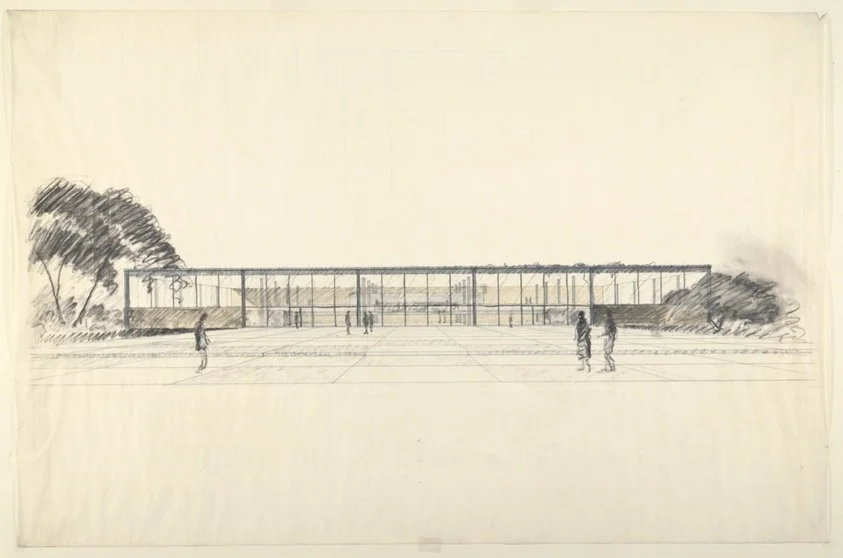
At the Ryerson & Burnham Archives, my archival work focused on transforming complex, largely unstructured materials related to architects who helped shape Chicago's architectural and cultural landscape into organized, searchable collections that could support future research, exhibitions, and public interpretation.
THE CONTEXT
The work centered on the personal and professional papers of Carter Manny and Gertrude Kerbis, two figures whose careers offer distinct perspectives on Chicago’s architectural history.
Manny’s career connected some of the defining forces in twentieth-century Chicago architecture—from studying under Mies van der Rohe and apprenticing with Frank Lloyd Wright, to working on the FBI Building, supporting public art initiatives throughout Chicago, and later directing the Graham Foundation. Kerbis was a trailblazing woman architect whose career included work at Skidmore, Owings & Merrill and Naess & Murphy (later C.F. Murphy) before establishing her own firm and expanding into real estate development.
THE METHOD
Each collection was processed and organized to establish an intellectual and physical structure. Research, categorization, and contextualization shaped finding aids that made complex bodies of information coherent and navigable for future researchers. Materials were also curated for digitization to support further research and access.
THE INTERPRETATION
Organizing the collections revealed connections between individual lives, professional practices, and the broader cultural landscape in which they operated. The resulting structure made visible the people, relationships, and ideas that shaped Chicago’s architectural history.
THE Access
The resulting finding aids and digitized materials created new pathways into the collections, making primary sources more accessible for research, interpretation, and public engagement.
MAPPING HOW INFORMATION BECOMES KNOWLEDGE
Pratt Institute, Master of Information and Library Science
Across my graduate research at Pratt Institute’s School of Information, I explored how people encounter, navigate, and interpret information across cultural institutions, archives, and digital environments. Through research, observation, and user-centered methods, projects examined how information can be organized, contextualized, and made more accessible.
Cultural institutions · Archives · Digital environments · User research · Information architecture · Experience design
THE CONTEXT
The research focused on how people discover, navigate, and engage with cultural information across physical and digital environments, including museums, archives, film institutions, and online platforms. Projects examined the relationship between information, users, and the systems through which knowledge is accessed and understood.
THE METHOD
Combining both qualitative and quantitative approaches, the research included interviews, surveys, observation, competitive analysis, personas, user journeys, card sorting, affinity diagramming, and prototype testing. These methods were used to understand user needs and behaviors, identify patterns, and evaluate how information and experiences could be structured around the people using them.
THE INTERPRETATION
Research findings were synthesized into insights about user behavior, information-seeking, navigation, and cultural engagement. Analysis translated observations and research findings into patterns, opportunities, and recommendations that informed information architecture, experience design, content strategy, and digital experiences.
THE Access
The work ultimately focused on making information easier to discover, navigate, understand, and use. Through information architecture, experience mapping, and digital prototyping, research was translated into structures and experiences designed to connect people with information in more intuitive and meaningful ways.
SELECTED RESEARCH PROJECTS
ARTinerary — User research · Audience insights · Experience design · Digital prototyping
Anthology Film Archives — User research · Information architecture · Usability testing · Digital prototyping
Intrepid Museum — Visitor research · User experience · Wayfinding · Experience design
Arts & Digital Culture: London — Cultural research · Digital humanities · Cultural access · Digital preservation
Maris Semel Archive — Archival research · User research · Digital exhibition · Usability testing